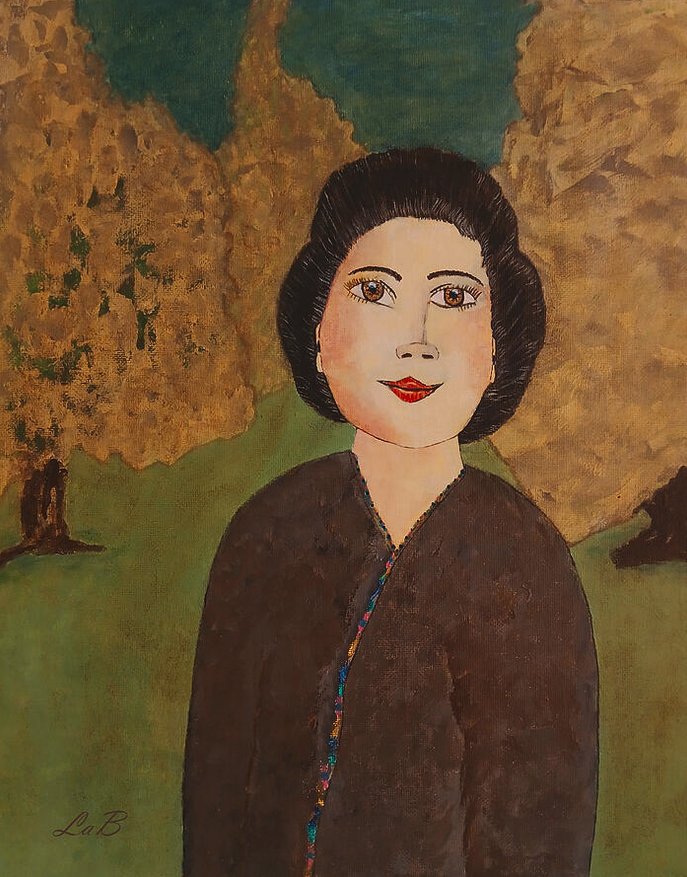
Portrait Woman in Orchard — LaB No110
A solitary figure stands among the orchard rows, her presence quiet yet resolute. The Midwestern walnut hull wash gives the portrait its warm, vintage glaze — a technique rooted in early regional craft where natural pigments were drawn directly from the land.
Fresh green walnut hulls hold a kind of alchemy. When sliced open, the liquid goes onto the canvas as a sharp lime green — almost like invisible ink in reverse. Instead of fading, it slowly comes into focus, shifting before your eyes into a soft copper tone. This is the first life of the walnut stain, alive and changing, as if the orchard itself is breathing color into the work.
If the hulls are left to darken and collapse into their blackened state, they release a deep, permanent ink — the same rich black once used by calligraphers and early American craftsmen. This dual nature of the walnut hull, from bright green to copper to midnight black, ties the piece directly to the land and its cycles. LaB No110 carries that transformation within its surface, a quiet chemistry of orchard, pigment, and time.
The orchard itself is symbolic: a place of memory, harvest, and reflection. The woman’s posture suggests both belonging and distance, as if she is part of the land yet drifting through it like a seasonal ghost.
LaB No110 marks this piece within the larger body of Clubheadart’s work — a catalog of experiments, stories, and techniques that trace the evolution of the artist’s hand. Each number is a chapter. This one is a quiet autumn afternoon preserved in walnut and light.
— Work by Clubheadart
📜 Curator’s Footnote — Ledger Entry for LaB No110
Entry No. 110 — Documentation of the orchard portrait and its accompanying narrative. The subject stands among the rows with a stillness that suggests both presence and departure. Noted here is the use of fresh green walnut hulls, applied in their first state: a lime‑colored wash that shifts to copper as it meets the air. This transformation has been verified as consistent with the artist’s method, tying the work directly to the land from which the pigment is drawn. Further observation: when the hulls are left to blacken, they yield a permanent ink once favored by calligraphers. This dual nature — green to copper, copper to black — mirrors the layered story recorded beneath the image. The orchard, the pigment, and the figure share a single thread: each carries a quiet history that reveals itself slowly. This entry confirms LaB No110 as a significant chapter in the artist’s ongoing ledger of experiments, techniques, and regional memory.
— M.A.